
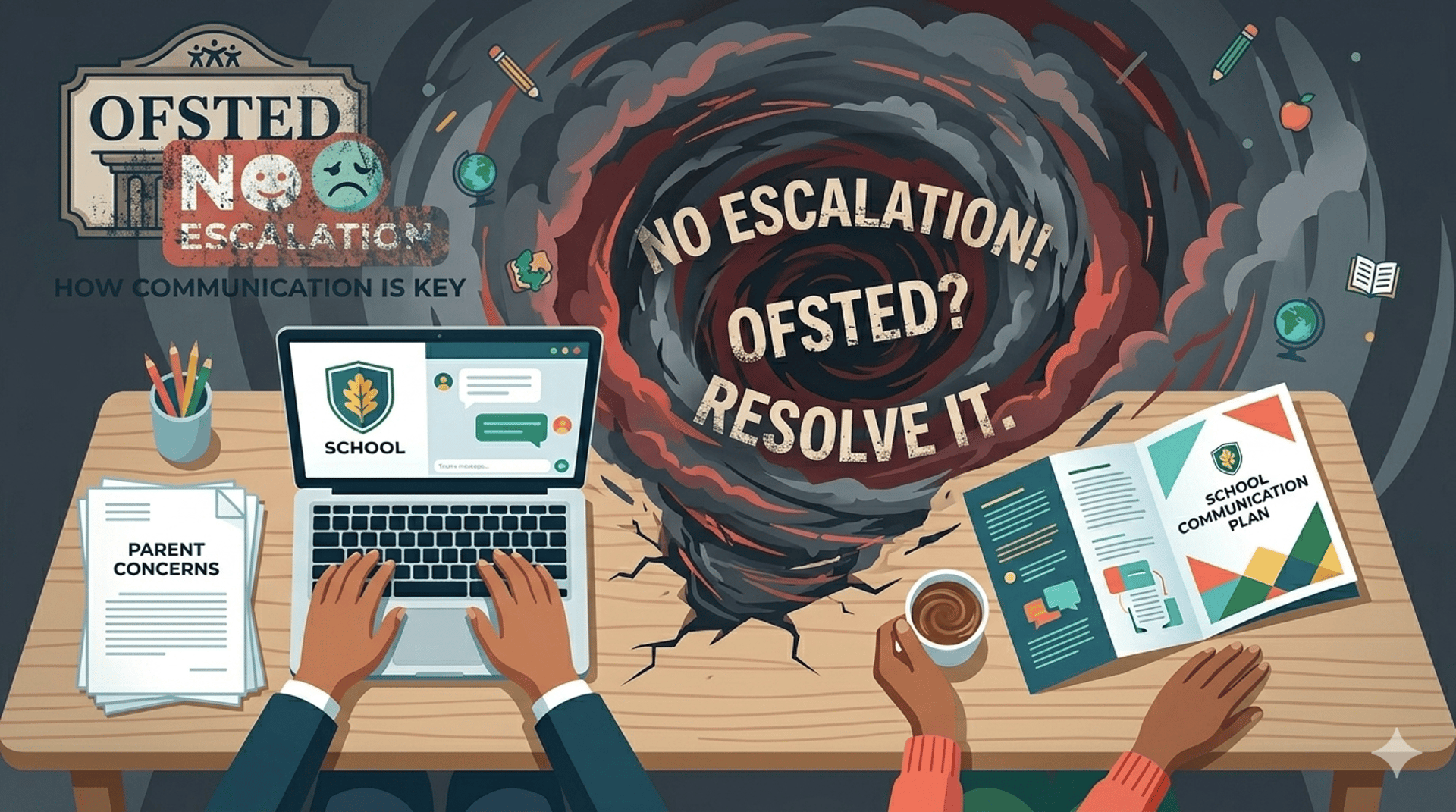
“I’M TAKING THIS STRAIGHT TO OFSTED!”
How Schools Communicate Their Way Out of High-Stakes Escalation
Alex Sandbrook
6/22/20266 min read
More often than not, by the time a complaint lands in a headteacher's inbox, the relationship has already taken significant damage. The parent is angry, trust has eroded and a parent feels unheard and unseen — and they've probably felt that way for a while.
So when they finally formalise their complaint — often now with a highly polished AI-assisted letter to hand — it isn't just a procedural step. For many parents, it's an act of desperation.
And for some, it's a declaration of war. The school just doesn't know it yet.
By this point, one or more of the following is almost certainly true:
They feel let down and are angry
Trust has nearly evaporated
They believe they haven't been heard — and fear they never will be
Their view of events has hardened into an indisputable truth
They have a fixed idea of what the only "acceptable" outcome looks like
They're entering the process assuming it's designed to protect the school and obscure the truth
And on the other side of the desk? Many school leaders feel something equally familiar: that the complaint is heading down a predictable and unavoidable track — straight toward further conflict, no matter what they do.
I wanted to talk about that exact moment — and why communication is, at that stage, the only tool left that can genuinely shift the outcome.
The Psychology of Escalation: The Amygdala Hijack
When a parent is in a heightened emotional state, the brain shifts into threat response. Facts become secondary, process feels irrelevant and assumptions fill in the gaps before you've had the chance to speak.
But this is so much more than just a difficult conversation; it is a neurological event.
Psychologist Daniel Goleman coined the term "Amygdala Hijack" to describe what happens when a psychological threat triggers our primal survival mechanisms. The amygdala — the brain's emotional core, or what trauma researchers call our internal "smoke detector" — cannot distinguish between a physical attack and a perceived threat to our children, our ego, or our values.
When someone (in this case, a parent) feels aggrieved, their amygdala instantly bypasses the prefrontal cortex — the rational, reasoning part of the brain. A surge of stress hormones locks them into a default "fight or flight" posture. In plain terms: their thinking brain has been taken offline.
The trap for school leaders is that these mechanics are contagious. When confronted by a hostile email or an aggressive parent, our own internal smoke detector goes off. Our natural instinct is to get defensive or protect our staff, which only pours petrol on the parent's fire.
This is why so many leaders feel: "No matter what we say, they won't listen." They are trying to apply logic to a biological state of alarm.
But communication — when it's handled deliberately and skilfully — can interrupt the cycle entirely. By understanding the neuroscience of conflict, we can soothe the parent's threat response, re-engage their prefrontal cortex, and bring the conversation back to a place of rational resolution.
The Three Biggest Mistakes Schools Make Under Pressure
Before exploring what works, it's worth naming what doesn't.
Mistake 1 — Trying to correct the record too quickly. When trust is already damaged, logic is futile - correcting before connecting escalates almost every time.
Mistake 2 — Withholding information for fear of saying the wrong thing. Silence is consistently misread as concealment or inaction.
Mistake 3 — Attempting to close down the complaint prematurely. A rushed conclusion signals dismissal — regardless of the intent behind it.
All three produce the same outcome: the parent feels unheard and any concerns that the process will not help them, appear validated. Which invariably is going only one way: escalation.
The Rule of Three: 3 Shifts that Change Everything
When a parent appears immovable, or intent on escalation, the instinct is to become defensive, which is completely understandable. But there's a far more effective approach — one grounded in conflict research and negotiation theory — that focuses on shifting the conversation rather than battling it.
Shift 1 — From positions to interests
A complaint is almost always a position — what they say. But the interest underneath — what they actually need — is where resolution lies.
The position: "Expel that disruptive student." The underlying interest: My child needs to feel safe.
The position: "The teacher is favouring others." The underlying interest: My child needs to feel recognised and seen.
The position: "I want an apology." The underlying interest: I need to feel that someone has taken this seriously.
One particularly useful question that unlocks this shift and moves the conversation from demands to needs is "What is your biggest concern here, and what outcome would help rebuild your confidence?"
Shift 2 — From blame to a shared goal
Even when a parent opens with criticism or hostility, it's possible to reframe the conversation around a shared goal: the best possible outcome for their child.
Start with genuine validation — not agreement, but acknowledgement:
"I can see how upsetting this is for you." "Thank you for raising this — I can hear how strongly you feel."
Validation creates safety. It signals that you're not there to be adversarial or to ‘win’, but to understand.
Then anchor the conversation in the future: "Let's focus on what we can do from here to ensure your child feels supported."
That single reframe turns "us versus them" into "us versus the problem."
Shift 3 — From crisis to opportunity
A highly charged complaint is uncomfortable — but it's also data. It might signal a policy that is unclear, a procedure that's inconsistent, or a communication gap that needs closing.
Handled well, these moments strengthen relationships, demonstrate leadership under pressure, and reduce future complaints. The schools that handle difficult complaints best are the ones that treat them not as threats, but as intelligence.
The CALM framework for high-stakes communication
Once the mindset shift is in place, leaders need a practical structure to act on it. This is where the CALM framework helps:
C — Clarify the concern. Strip away the noise and the kitchen-sink history. What is the single, core issue the parent needs resolved today?
A — Acknowledge emotion. Reflect their emotional state before you touch the facts. "I can hear how frustrating this has been for you." This isn't conceding a point; it's dropping the anchor of de-escalation.
L — Layer the context. Provide information plainly and directly without slipping into organisational defensiveness. Clarify the why behind the policy.
M — Map the next step. Give them one concrete, time-bound action. Nothing escalates anxiety faster than a parent wondering, "What happens now?"
Tone is everything — even when outcomes can't change
A parent can disagree with a decision and still leave the process feeling heard, respected, and treated with dignity. That outcome is almost entirely determined by tone.
Research into customer experience consistently shows: tone determines the emotional outcome, while process determines the practical one. Schools need both — and too often focus only on the latter.
Trust repair is a process, not a moment
When trust has broken down, rebuilding it requires consistency and honesty, over time. Whilst the foundations might seem straightforward, they have to show up in every interaction:
Transparency: "Here is what we can share at this stage."
Consistency: "As I said on Wednesday, the next step is..."
Follow-through: "As promised, here is the update."
Clear boundaries: "I can't comment on that aspect — but what I can explain is..."
Saying these things once isn't enough. The pattern of doing them, repeatedly, is what rebuilds confidence.
Communicating findings parents won't like
This is where leaders feel most exposed. When delivering an outcome a parent won't welcome, the rules shift:
Separate the parent's emotional experience from your operational conclusion.
Acknowledge valid distress without conceding inaccurate claims.
Explain the process clearly, factually, and transparently.
A line that often anchors this moment:
"While I understand this may not be the outcome you were hoping for, I want to reassure you that the investigation was thorough, fair, and focused on the well-being of all students involved."
Whilst it certainly doesn't change the finding, it transforms how the finding is received.
Leadership is loudest during conflict
Parents aren't just assessing the situation. They're assessing the school's culture, its leadership, and its integrity.
How a complaint is handled communicates competence, care, and values more clearly than almost anything else a school does. The leaders who understand this — and who treat communication as a discipline rather than an afterthought — are consistently the ones who resolve complaints without escalation.
That's what calm, confident, principled complaint handling looks like.
At Aesendia Advisory, I work with schools to bring structure and clarity to the most complex complaints — including the ones where relationships have already broken down. If you're dealing with a situation that feels stuck or is heading toward escalation, that's exactly where I can help.
Follow & Connect:
Fully insured for Consultancy and Advisory Services
© Aesendia Advisory 2025. All rights reserved.
Contact
Legal
Quick Links


enquiries@aesendia.co.uk

Registration No: ZB985599